Rockhampton grew fast after the 1850s gold rushes, with early builders laying foundations on alluvial flats along the Fitzroy River. That choice still matters today. The city's fluvial sediments, stiff clays, and occasional sand layers create a variable subgrade that demands careful assessment. We carry out differential settlement analysis in Rockhampton to help engineers avoid costly structural damage. Our approach combines AS 1726 borehole logging, lab consolidation tests, and field data. For deeper insight into subgrade behavior, we often pair this analysis with a resistivity survey to map soil variability across a site before any foundation design.
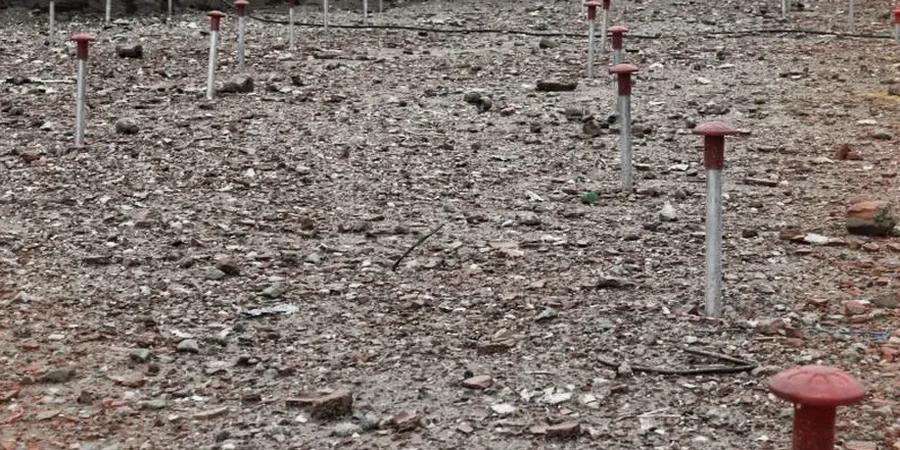
Variable alluvial deposits across Rockhampton mean differential settlement risk is high — one borehole every 500 m² is rarely enough to capture the full picture.
Scope of work
Area-specific notes
The alluvial clays along the Fitzroy River floodplain are often soft to firm, with occasional lenses of loose sand. This layered geology creates a classic differential settlement scenario — one side of a footing may bear on stiff clay while the other sits on compressible silt. In Rockhampton's older suburbs like Allenstown or Depot Hill, we have seen houses with cracked masonry and uneven floors traced directly to this variability. The risk spikes after prolonged wet seasons when the clay's moisture content rises and bearing capacity drops. Our differential settlement analysis in Rockhampton quantifies these risks using site-specific consolidation data and settlement modelling.
Standards used
AS 1726 – Geotechnical Site Investigations, AS 4678 – Earth Retaining Structures, AS 1289.6.6.1 – Standard Test Method for One-Dimensional Consolidation Properties of Soils
Linked services
Consolidation Testing (Oedometer)
Laboratory oedometer tests on undisturbed tube samples to determine Cc, Cs, Cv, and pre-consolidation stress. Results are interpreted against local alluvial clay databases for reliable settlement predictions.
Settlement Monitoring & Instrumentation
Installation of settlement plates, inclinometers, and piezometers on active building sites. We track real-time movement during and after construction to verify design assumptions and trigger corrective action if needed.
Numerical Modelling (Settlement Analysis)
Finite element modelling using Plaxis or Settle3 to simulate one-dimensional and differential settlement under proposed loads. We calibrate models with local consolidation data and report allowable settlements per AS 2870.
Typical parameters
FAQ
What causes differential settlement in Rockhampton soils?
The main cause is the variable alluvial geology along the Fitzroy River. Layers of soft clay, loose sand, and stiff clay alternate within short distances. Seasonal moisture changes also soften the clay, increasing compressibility under load.
How does your analysis comply with Australian standards?
We follow AS 1726 for site investigation and AS 4678 for settlement design. Oedometer tests are run per AS 1289.6.6.1, and modelling adheres to AS 2870 for residential slabs and footings. All reports are signed by a chartered geotechnical engineer.
How many boreholes are needed for a reliable settlement analysis?
For a typical house block in Rockhampton, we recommend a minimum of two boreholes to 8 metres depth. Larger commercial sites require one borehole per 500 m², with additional test pits where shallow utilities or fill are present.
Can you model differential settlement for existing buildings?
Yes. We survey existing cracking, install settlement pins, and correlate surface observations with borehole logs. Our numerical models then back-analyse the likely movement and predict future behaviour under current conditions.
What is the typical cost range for a differential settlement study?
For a standard residential project, the study ranges between AU$970 and AU$2,740 depending on borehole depth, number of oedometer tests, and modelling complexity. Commercial projects with deeper bores and multiple load cases fall at the higher end.