Rockhampton sits at an elevation of 11 meters on the Fitzroy River floodplain, where seasonal rainfall exceeds 800 mm annually. That combination creates a tough setting for any road embankment design: reactive clay profiles shrink and swell with moisture, and shallow groundwater complicates compaction. Our team addresses these conditions through site-specific geotechnical investigation, including soil classification and strength testing. Before placing any fill, we run subgrade evaluation to determine the in-situ support capacity, and we integrate compaction control with sand cone to verify field density meets specification. Every embankment project we take on in Rockhampton starts with a clear understanding of the local soil behaviour and drainage regime.
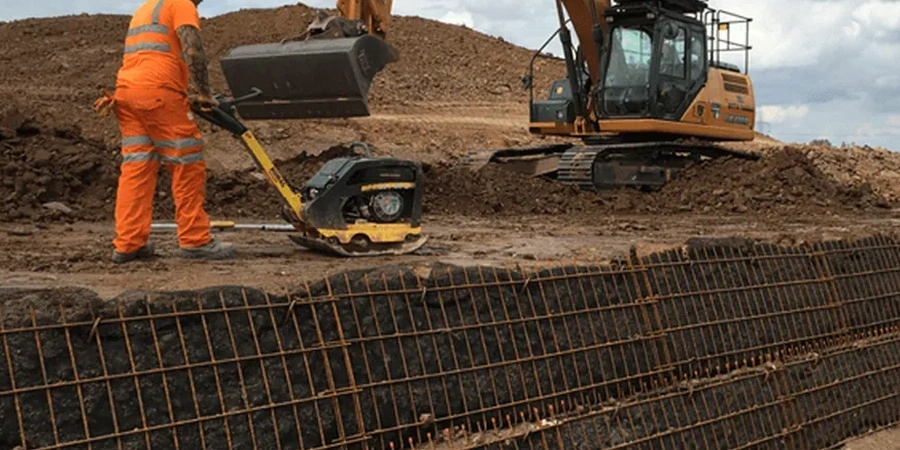
Reactive vertosols with plasticity indices over 40 percent demand moisture-sensitive compaction control and staged construction to avoid long-term differential settlement in embankments.
Scope of work
Area-specific notes
In Rockhampton we often see embankments constructed during the dry season that crack severely after the first wet period. The root cause is insufficient moisture control during placement: the fill dries out, then swells unevenly when rain returns. Differential settlement follows, cracking the pavement surface. Our road embankment design protocol includes a pre-construction moisture conditioning plan and post-construction monitoring. We also check for dispersive soils using pinhole tests, since some local alluvial clays are prone to internal erosion. Ignoring these risks leads to premature failure and expensive remedial work.
Standards used
AS 1726:2017 — Geotechnical site investigations, AS 4678:2002 — Earth-retaining structures, AS/NZS 1170.2:2021 — Structural design actions (wind loads), Austroads Guide to Pavement Technology Part 4F: Earthworks
Linked services
Site Investigation & Soil Profiling
Boreholes, test pits, and continuous sampling to characterise the foundation stratigraphy and identify problematic clay layers.
Compaction Control Testing
Field density tests using sand cone and nuclear gauge, correlated with laboratory Proctor curves to ensure fill meets specification.
Slope Stability Analysis
Limit-equilibrium and finite-element modelling of embankment slopes under static, seepage, and seismic conditions.
Settlement & Consolidation Assessment
One-dimensional consolidation tests and numerical modelling to predict primary and secondary settlement under fill loads.
Typical parameters
FAQ
What makes road embankment design in Rockhampton different from other regions?
The combination of high-plasticity vertosols and a shallow water table means compaction moisture control is critical. Design must account for up to 100 mm of seasonal volume change in the subgrade, which drives both fill specifications and drainage design.
How much does a road embankment design study typically cost in Rockhampton?
For a standard project the cost ranges between AU$1,960 and AU$6,940, depending on site access, number of boreholes, and laboratory testing required. We carry out a fixed-price quote after the initial site review.
Which Australian standards apply to embankment design in this area?
Primary references include AS 1726 for site investigation, AS 4678 for earth-retaining structures, and the Austroads Guide to Pavement Technology Part 4F for earthworks. Local council guidelines may also specify minimum compaction requirements.