Rockhampton sits on deep alluvial deposits from the Fitzroy River, and many sites here contain soft clays and silts that consolidate slowly under load. We see this especially in industrial yards and road embankments on the floodplain. Prefabricated vertical drains accelerate the settlement process by providing horizontal flow paths for pore water, which reduces the time needed for preloading. A proper PVD design must account for smear zone effects from mandrel installation and the drainage length between wick drains. Before specifying a drain pattern, we always check the clay's consolidation coefficient using oedometer tests and correlate it with field data from a permeability test in the field to validate flow assumptions.
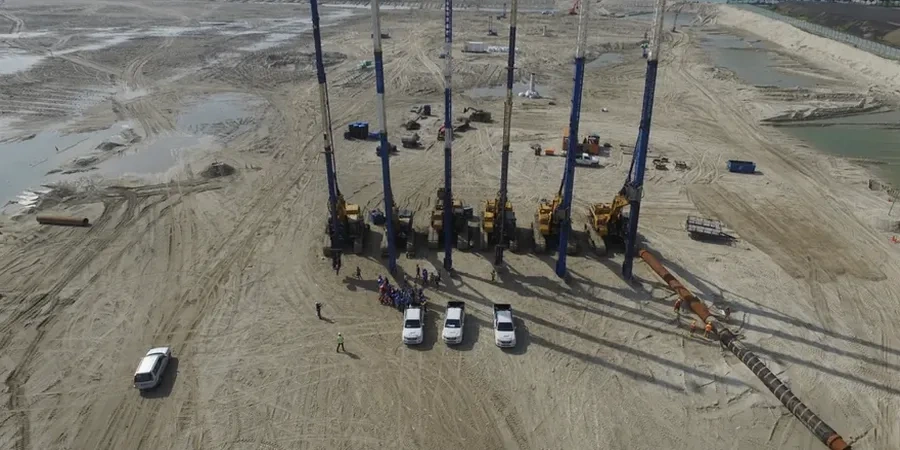
A properly designed PVD grid can achieve 90% consolidation in soft Fitzroy River clays within 4 to 6 months instead of 3 to 5 years.
Scope of work
Area-specific notes
Rockhampton's urban expansion into low-lying areas near the Fitzroy River has pushed infrastructure onto compressible alluvial clays. Early subdivisions in the 1970s experienced differential settlements of up to 400 mm, cracking road pavements and tilting house slabs. The risk is that poorly designed drainage systems fail to dissipate excess pore pressure quickly enough, leading to long-term creep and slope instability along flood channels. Our PVD designs incorporate a minimum factor of safety of 1.5 for embankment stability during the consolidation phase, and we always verify the clay's sensitivity to avoid remolding issues during installation.
Standards used
AS 1726:2017 Geotechnical site investigations, AS 4678:2002 Earth retaining structures, FHWA NHI-05-037 (PVD design guidelines), AS 1289.6.6.1 Standard test methods for one-dimensional consolidation
Linked services
PVD Layout and Spacing Design
We determine optimal drain spacing and depth based on consolidation parameters from lab tests and field data. The design includes a settlement versus time curve that predicts when preloading can be removed, allowing contractors to plan the project schedule with confidence.
Instrumentation and Performance Monitoring
We install settlement plates, piezometers, and inclinometers to track pore pressure dissipation and lateral displacement during surcharging. Data is reviewed weekly, and we adjust the drain pattern if actual consolidation lags behind the predicted rate.
Typical parameters
FAQ
What is the typical cost for a PVD design study in Rockhampton?
The fee for a prefabricated vertical drain design study in Rockhampton ranges from AU$1,200 to AU$3,700 depending on site complexity, number of boreholes, and whether instrumentation is included. We carry out a fixed-price quote after reviewing the existing geotechnical report.
How long does consolidation take with PVDs in Rockhampton clays?
In the soft alluvial clays along the Fitzroy River, a well-designed PVD system typically achieves 90% consolidation within 4 to 6 months. Without drains, the same process would take 3 to 5 years. The actual duration depends on drain spacing, clay compressibility, and the height of the surcharge fill.
What site investigation data is needed before PVD design?
We require at least two boreholes with undisturbed sampling for oedometer tests to obtain the coefficient of consolidation and compression index. A field permeability test is also recommended to verify horizontal drainage assumptions. Existing borehole logs from nearby Rockhampton projects can sometimes reduce the investigation scope.
Can PVDs be used for road embankments in Rockhampton?
Yes, PVDs are commonly specified for road embankments on the Rockhampton floodplain. We design the drain grid to prevent differential settlement at bridge approaches and culvert crossings. The system works well with staged construction, allowing the embankment to gain strength as the underlying clay consolidates.