Rockhampton's development along the Fitzroy River has shaped a unique geotechnical setting. The city's growth since the 1850s brought construction onto deep alluvial terraces and bedrock margins. Modern projects now face variable soil profiles that demand careful seismic evaluation. A site response analysis isolates how local ground conditions modify earthquake waves before they reach the foundation. This study predicts amplification patterns, resonance periods, and spectral accelerations specific to the site. Without it, engineers risk designing structures that do not match the actual shaking demands of central Queensland's subsurface. The analysis typically combines shear-wave velocity profiling, stratigraphic logging, and dynamic laboratory testing. For shallow foundations on stiff clay, the work often pairs with a compression test to define undrained strength. On sites with thick sand layers, a MASW survey provides reliable Vs30 values for site class assignment.
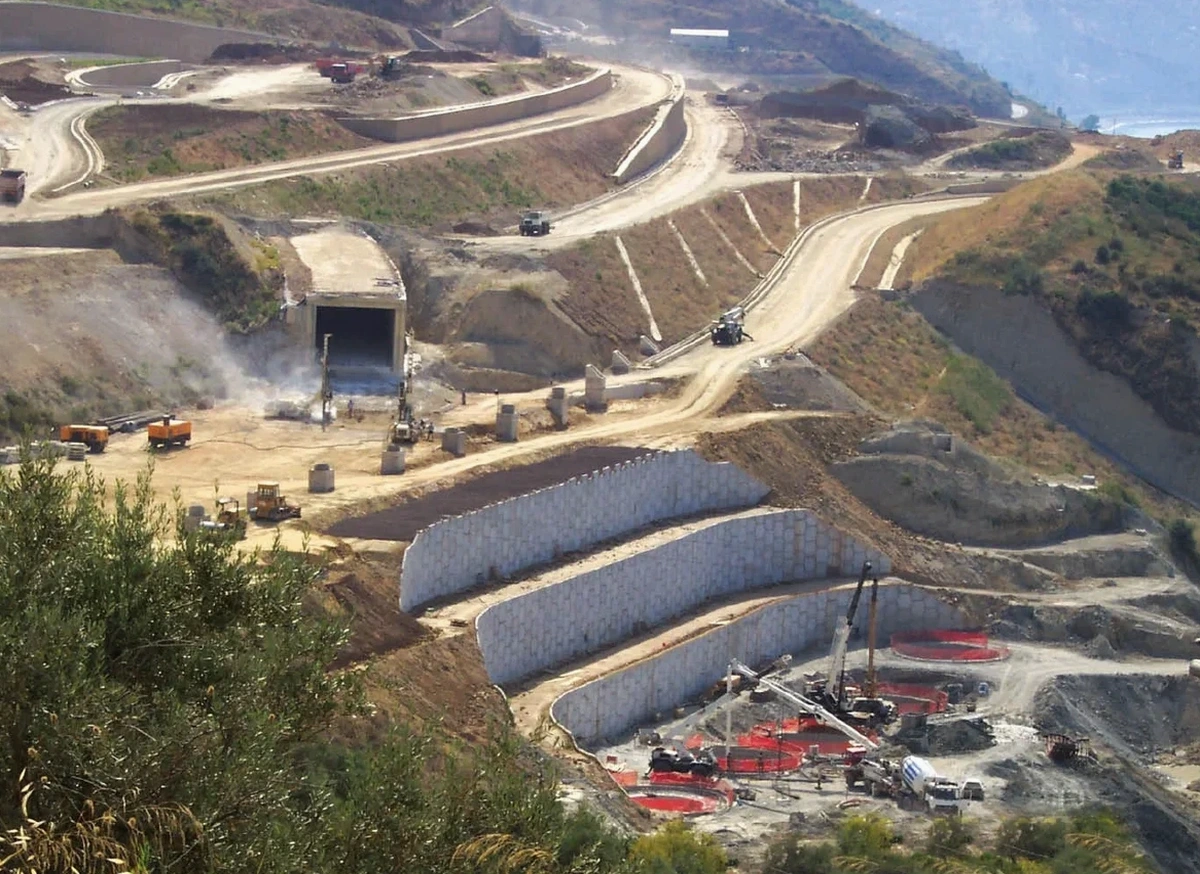
A site response analysis in Rockhampton isolates how local alluvial and residual soils modify earthquake waves before they reach the foundation.
Scope of work
Area-specific notes
Rockhampton sits in a moderate seismic zone with recorded earthquakes up to magnitude 5.5 within 100 km. The 1967 Bundaberg event caused notable ground motion in the region. Local alluvial plains amplify low-frequency waves, endangering multi-story structures on deep soil. A site response analysis identifies these resonances before they damage the building. Without it, designers may assume uniform shaking across a block, missing areas where soft pockets concentrate energy. The city's flood-prone terraces compound the risk: saturated soils lose shear strength and amplify motion further. For projects near the Fitzroy River, the study must also evaluate liquefaction triggering using the cyclic stress ratio from the response output.
Standards used
AS 1170.4:2007 (Earthquake actions), AS 1726:2017 (Geotechnical site investigations), NEHRP Recommended Seismic Provisions (FEMA P-1050), NCEER 1997 (Youd-Idriss liquefaction procedure)
Linked services
Shear-Wave Velocity Profiling
MASW and ReMi surveys to measure Vs30 and define the site class per AS 1170.4. Suitable for both greenfield and developed sites.
Dynamic Laboratory Testing
Resonant column and cyclic triaxial tests on undisturbed samples to obtain G/Gmax reduction and damping curves for local soils.
Ground Response Modeling
1D and 2D equivalent-linear or nonlinear analysis using site-specific input motions. Output includes acceleration time histories and response spectra.
Typical parameters
FAQ
What is the difference between a site response analysis and a standard seismic hazard assessment?
A seismic hazard assessment estimates bedrock shaking from regional faults. A site response analysis then propagates that motion through the local soil column to predict ground-surface shaking. Rockhampton's alluvial deposits can amplify bedrock motions by a factor of 1.5 to 2.5, so the response study is essential for accurate design spectra.
How much does a site response analysis cost in Rockhampton?
Costs typically range between AU$2.130 and AU$7.000 depending on the number of boreholes, laboratory tests, and complexity of the soil profile. A standard single-borehole study with MASW and basic modeling falls near the lower end. Multi-borehole projects with advanced nonlinear analysis reach the upper end.
Do I need a site response analysis for a two-storey house in Rockhampton?
Not usually. AS 1170.4 exempts low-rise residential buildings on Class A or B sites from detailed response analysis. However, if the house sits on deep soft clay near the Fitzroy River (Class E), or if the design includes irregular geometry, a simplified response check may be required.