Soils in the Berserker Range foothills tend to be stiff residual clays, while the Fitzroy River floodplain near Depot Hill has soft alluvial deposits with higher compressibility. That contrast makes the Flat Dilatometer Test (DMT) in Rockhampton particularly useful — it measures horizontal stress index and material index in a single push, giving us a continuous profile without extracting samples. We can tell within hours whether a site has overconsolidated clays or loose sandy layers that might settle unevenly. For deep foundation design we often combine DMT data with a pile friction and end-bearing assessment to refine shaft resistance estimates.
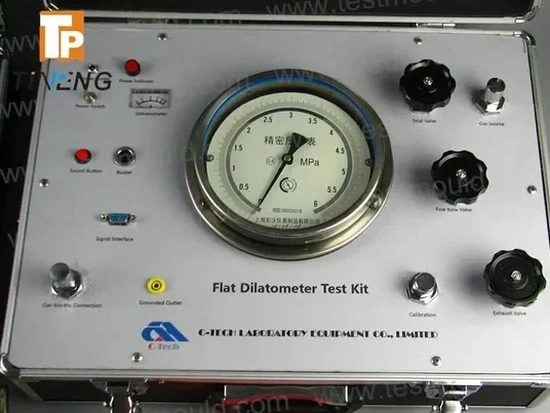
In Rockhampton's alluvial clays, DMT-derived constrained modulus values range from 8 to 35 MPa — critical data for estimating immediate and consolidation settlements.
Scope of work
Area-specific notes
The DMT blade itself is 95 mm wide and 15 mm thick, with a stainless steel membrane on one face. When we deploy it in Rockhampton's gravelly layers near the Berserker foothills, the main risk is membrane rupture from sharp particles — that costs downtime and recalibration. We mitigate this by running a pre-test with a dummy blade to clear obstructions. If the membrane tears at depth, we lose the profile segment and have to restart from surface. That's why we log every 200 mm and check membrane integrity after each 5 m drive.
Standards used
AS 1726:2017 Geotechnical Site Investigations, AS 1289.6.5.2 Standard Test Method for Flat Dilatometer, ISSMGE TC16 Marchetti Dilatometer Test Guidelines (2001)
Linked services
DMT with Seismic Module
We add a seismic receiver to measure shear wave velocity at each test depth. This gives you VS profiles for dynamic analysis and site classification per AS 1170.4 — useful for projects near the Rockhampton earthquake zone.
Dissipation Testing
After reaching a target depth, we stop blade advance and record pore pressure decay. In the low-permeability clays of the Fitzroy floodplain, this yields consolidation coefficients (ch) between 0.5 and 5 m²/year.
DMT-SPT Correlation Service
We run alternating DMT and SPT soundings at the same borehole to build site-specific correlations. This allows you to convert existing N-values into lateral stress parameters without additional field time.
This service complements our laboratory testing work for a complete project analysis.
Typical parameters
Watch how it works
FAQ
How does the Flat Dilatometer Test (DMT) differ from a CPT or SPT?
The DMT measures horizontal stress and material index directly — parameters that CPT and SPT do not carry out. While CPT gives cone resistance and sleeve friction, and SPT gives blow counts, the DMT yields constrained modulus and lateral earth pressure coefficient, which are essential for settlement analysis and retaining wall design.
What is the typical cost range for a DMT in Rockhampton?
For a standard profile to 20 m depth in accessible terrain, expect between AU$1,280 and AU$1,590. This includes mobilization within the Rockhampton region, membrane calibration, and a digital report with interpreted parameters. Rates may vary for deeper profiles or sites requiring tracked rig access.
Can DMT data be used for liquefaction assessment?
Yes, but indirectly. The DMT provides horizontal stress index (KD), which correlates with cyclic resistance ratio. We apply the Marchetti and Monaco methods to estimate liquefaction potential from KD values. For a full liquefaction analysis, we combine DMT with SPT or CPT data per NCEER guidelines.
How deep can the DMT reach in Rockhampton soils?
In the alluvial clays of the Fitzroy floodplain, we routinely reach 30 m using a 20-tonne CPT rig. In the residual soils of the Berserker foothills, hard layers may limit advance to 15–20 m. We assess refusal criteria on site and can switch to a percussion-based method if needed.