We recently worked on a haul road upgrade near the Rockhampton Airport, where the existing subgrade was a mix of clay and weathered basalt. The client needed reliable bearing values before committing to pavement thickness. Our team ran a series of CBR tests and dynamic cone penetrometer profiles to characterise the subgrade strength. That data fed directly into the flexible pavement design, avoiding over-design and saving the project around 15 percent on base course material. For deeper profiles, we combined this with granulometria to check aggregate suitability for the pavement layers.
Expansive clays in Rockhampton can cause up to 50 mm of differential movement under a pavement if the subgrade is not treated with lime or cement stabilisation.
Scope of work
- Soaked CBR values for subgrade in Rockhampton typically range from 2 to 8 percent
- Modified Proctor densities sit around 1.8 to 2.1 t/m³
- Linear shrinkage often exceeds 5 percent in the clay zones
Area-specific notes
Rockhampton's urban expansion into areas like Norman Gardens and Parkhurst has pushed roads onto former floodplains and low-lying terrain. The risk of subgrade softening during wet seasons is real. Without proper drainage and stabilisation, pavements develop rutting, cracking, and premature failure. We have seen cases where untreated clay subgrades under residential streets lost 40 percent of their CBR after a single wet season. That is why we always recommend a site-specific road geotechnics investigation before any pavement design in this region.
Standards used
AS 1726 – Geotechnical site investigations, AS 1289.6.1.1 – CBR test method, Austroads Guide to Pavement Technology Part 2
Linked services
Subgrade Investigation and CBR Testing
Field and laboratory CBR testing on undisturbed and recompacted samples, plus DCP profiling, to classify subgrade strength for flexible and rigid pavement design.
Expansive Soil Assessment and Stabilisation Design
Identification of shrink-swell clays through Atterberg limits and linear shrinkage, followed by lime or cement dosage recommendations to reduce volume change risk.
Pavement Layer Compaction Control
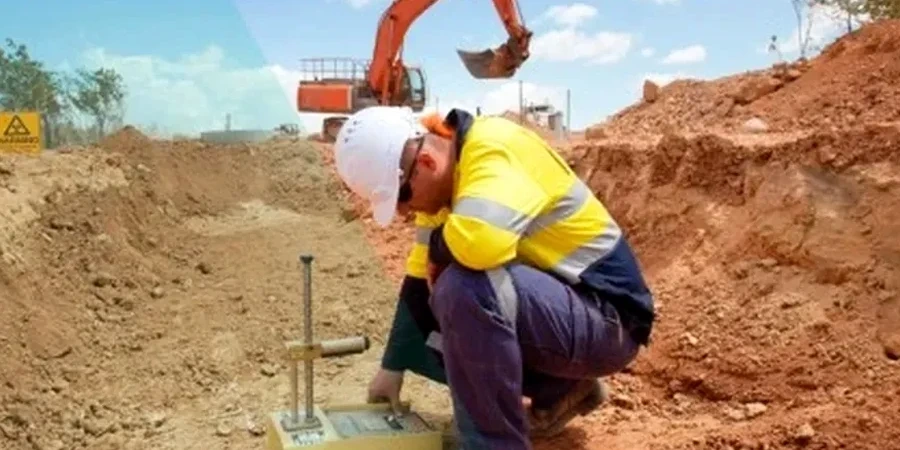
In-situ density testing (nuclear gauge or sand replacement) on base and sub-base layers, with moisture content adjustment to meet project specifications.
Typical parameters
FAQ
What CBR value is typically expected for subgrade in Rockhampton?
For natural clay subgrades in Rockhampton, soaked CBR values usually fall between 2 and 8 percent at 100 percent MDD. Sandy or gravelly zones can reach 15 percent or higher.
How much does a road geotechnics investigation cost in Rockhampton?
A standard investigation for a local road project typically costs between AU$1,250 and AU$6,850, depending on the number of test pits, CBR tests, and laboratory analysis required.
What tests are essential for pavement design on expansive clays?
Atterberg limits, linear shrinkage, and soaked CBR are essential. We also recommend swell pressure tests and stabilisation trials if lime or cement treatment is planned.
How long does a typical subgrade investigation take in Rockhampton?
Fieldwork usually takes one to two days for a standard residential street. Laboratory testing adds another five to seven working days before the report is ready.
What Australian standards apply to road geotechnics in Queensland?
AS 1726 governs site investigation, AS 1289.6.1.1 covers CBR testing, and the Austroads Guide to Pavement Technology provides design guidance for Queensland conditions.