Rockhampton sits on the alluvial plains of the Fitzroy River, where deep sand and clay layers alternate unpredictably. The region's subtropical climate drives high moisture content year-round, which directly affects soil density and consistency. For any foundation design here, reliable in-situ resistance data is non-negotiable. That is exactly what the SPT (Standard Penetration Test) delivers. It measures blow counts per 300 mm penetration, giving engineers a direct N-value profile of the subsurface. This test is quick, cost-effective, and has decades of correlation data behind it. We have performed hundreds of these tests across Rockhampton, from the developing northern suburbs to the industrial zones near the river. Each borehole tells a different story. Our job is to read that story accurately.
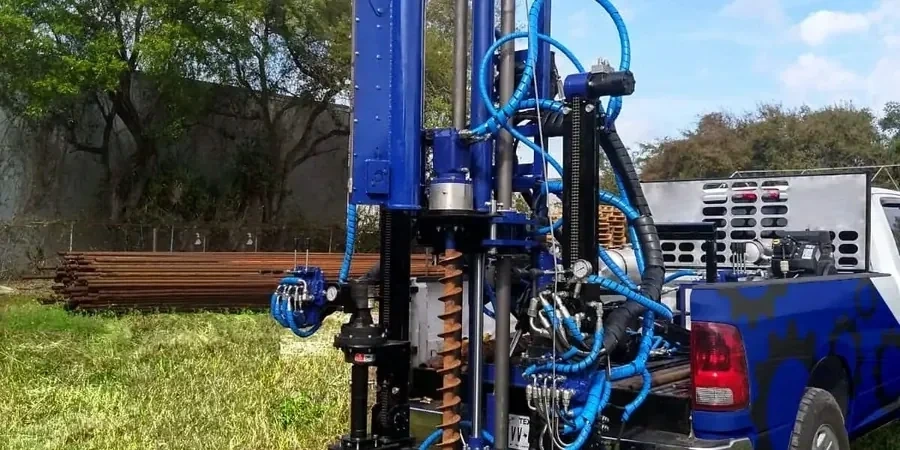
A single SPT boring in Rockhampton can reveal the difference between a shallow footing design and a deep pile solution, saving both time and budget.
Scope of work
Area-specific notes
Rockhampton recorded a population of over 80,000 in the 2021 census, with steady urban expansion into former floodplains. The Fitzroy River flood risk is well documented, but less discussed is the seismic hazard. The region sits in a moderate seismic zone under AS/NZS 1170.4. Loose saturated sands, common near the river, can liquefy under cyclic loading. The SPT N-value is the primary input for liquefaction triggering analysis per the NCEER (Youd-Idriss 2001) method. Without site-specific N-values, engineers must assume worst-case scenarios, which leads to over-designed foundations. That adds cost. Worse, underestimating liquefaction potential can lead to differential settlement or foundation failure. A proper SPT campaign mitigates both risks.
Watch how it works
Standards used
AS 1726-2017 Geotechnical Site Investigations, AS 1289.6.3.1 Standard Test Method for SPT, AS/NZS 1170.4 Structural Design Actions – Earthquake, NCEER (Youd-Idriss 2001) Liquefaction Assessment
Linked services
Standard SPT Borings with Sampling
Full SPT execution at specified depths with split-barrel sample recovery. We carry out N-value logs and sealed sample transport to our NATA lab.
N-Value Correlation Reports
We interpret raw blow counts into design parameters: bearing capacity, friction angle, and relative density. Reports include corrections for overburden and energy ratio.
Liquefaction Potential Assessment (SPT-based)
Using N-values from the test, we evaluate cyclic resistance ratio (CRR) against seismic demand. Output includes factor of safety against liquefaction per depth.
Typical parameters
FAQ
How deep does an SPT boring typically go in Rockhampton?
Depths range from 6 to 20 meters depending on the structure and soil profile. For residential slabs, 6 m is common. For commercial buildings or bridges, we extend to 15-20 m to reach competent bearing strata.
What is the difference between N-value and corrected N-value?
The raw N-value is the blow count measured in the field. The corrected N-value (N60 or N1,60) adjusts for hammer energy efficiency, rod length, overburden pressure, and borehole diameter. Corrections are essential for liquefaction analysis and bearing capacity correlations.
How much does an SPT test cost in Rockhampton?
The typical cost range for an SPT boring with sampling in Rockhampton is between AU$760 and AU$1,300 per borehole, depending on depth, access conditions, and number of tests per meter. Volume discounts apply for multiple boreholes.
Can SPT be performed in wet or waterlogged ground?
Yes, SPT works in saturated conditions. The test is performed inside a borehole that may be cased or filled with drilling fluid to maintain stability. Water table depth is recorded during drilling and factored into the interpretation.