Rockhampton sits on the Fitzroy River floodplain, where the soil profile typically alternates between high-plasticity clays and loose sandy silts down to 15 meters. The water table fluctuates seasonally, often sitting at 3 to 5 meters below grade in the city center. Our soil mechanics study addresses these conditions by performing boreholes with SPT at every 1.5-meter interval, plus undisturbed tube sampling for triaxial and consolidation testing. Before any foundation layout, we cross-check the data with a granulometry analysis to confirm the sand-silt-clay fractions, and we assess the clay's activity through Atterberg limits. The goal is to define the bearing capacity and predict settlement for residential slabs or commercial footings. Every investigation follows AS 1726-2017 for soil classification and AS 4678-2002 for earth-retaining structures, ensuring the report meets local council requirements. Our laboratory in Rockhampton holds NATA accreditation under ISO 17025, so the results are defensible in any engineering review.
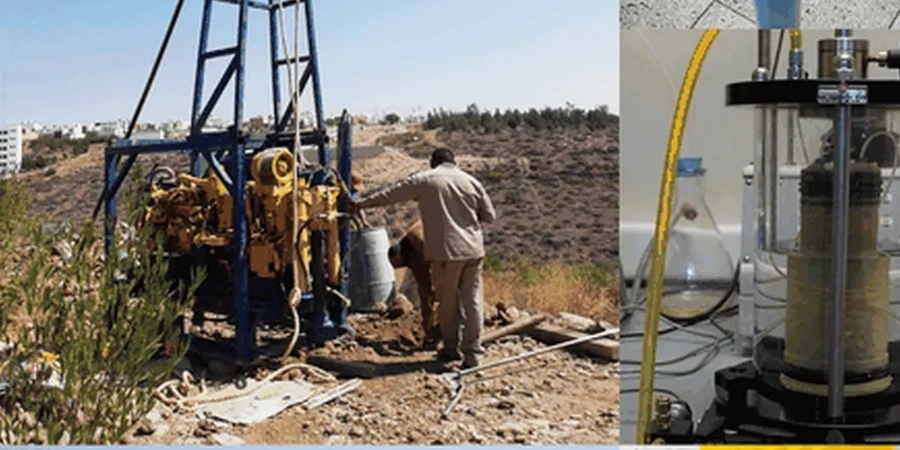
The reactive clays in Rockhampton can change volume by up to 15 percent, making a soil mechanics study the only reliable basis for foundation design.
Scope of work
- Borehole drilling with continuous SPT logs (AS 1289.6.3.1)
- Classification testing (grain size, Atterberg, moisture content)
- Shear strength via triaxial CU tests (AS 1289.6.4.2)
- One-dimensional consolidation for settlement estimates
Each parameter is plotted against depth, so the structural engineer has a clear picture of the ground's response to loading.
Area-specific notes
The wet-dry cycle in Rockhampton is the main trigger for foundation problems. During the dry season (May to September), the clay shrinks and cracks open up to 50 mm wide. When the rain returns, the clay swells, exerting uplift pressures that can lift slabs and crack brick veneer walls. Our soil mechanics study identifies the depth of the active zone — typically 2 to 3 meters — and quantifies the swelling pressure using oedometer tests with inundation. If the soil is classified as highly reactive (PI > 35 and shrinkage index > 4), we recommend stiffened raft slabs or deep piers to bypass the active layer. We also check for collapsible soils in the alluvial deposits near the river, which can settle suddenly when wetted. Ignoring these risks leads to differential settlement that is expensive to repair.
Standards used
AS 1726-2017 Geotechnical site investigations, AS 4678-2002 Earth-retaining structures, AS 1289.6.3.1 Standard Test Method for SPT, AS 1289.6.4.2 Standard Test Method for Triaxial Compression (CU)
Linked services
Standard Site Investigation (Residential & Light Commercial)
For houses, townhouses, and small warehouses. We drill 2 to 4 boreholes per lot to 6–10 meters depth, perform SPT at 1.5 m intervals, and collect undisturbed samples for classification and strength tests. The final report provides bearing capacity, settlement predictions, and foundation recommendations under AS 2870 for residential slabs.
Advanced Geotechnical Investigation (Industrial & Infrastructure)
For larger projects like bridges, retaining walls, or subdivisions. We drill boreholes up to 20 meters deep, run down-hole seismic tests for shear wave velocity, and perform triaxial CU, oedometer, and permeability tests. The report includes settlement analysis under service loads, slope stability for cuts, and liquefaction assessment per AS/NZS 1170.4 seismic criteria.
Typical parameters
FAQ
How deep do you drill for a soil mechanics study in Rockhampton?
For standard residential sites we drill to 6–10 meters, or until we have penetrated the active clay zone and reached a competent bearing stratum. For commercial or industrial projects we go to 15–20 meters, depending on the foundation load and the presence of soft alluvial layers. The depth is always justified in the report based on the soil profile encountered.
What is the typical cost range for a soil mechanics study in Rockhampton?
A standard residential investigation (2–4 boreholes with SPT and basic laboratory tests) ranges from AU$4,330 to AU$8,460, depending on the number of boreholes, depth, and laboratory work required. For larger or more complex projects the cost is quoted individually based on scope. Contact us for a site-specific quote.
How long does it take to get the soil mechanics report after drilling?
Fieldwork usually takes one to two days for a residential site. The laboratory testing (triaxial, consolidation, classification) takes another 7 to 10 working days. The full report is delivered within 12 to 15 working days from the start of drilling, provided the samples are undisturbed and the testing schedule is standard.
Do I need a soil mechanics study for a slab-on-ground in Rockhampton?
Yes, strongly recommended. Rockhampton's reactive clays cause seasonal movement that can crack concrete slabs. The study classifies the site per AS 2870 (A, S, M, H1, H2, E) and specifies the slab type (stiffened raft, waffle raft, or deep piered). Without it, the builder assumes all risk for differential movement. The local council may also require the report for building approval on reactive sites.