The contrast between the deep alluvial clays of the Kawana-Wandal corridor and the weathered rock zones near Mount Archer demands a fundamentally different approach to retaining wall design in Rockhampton. On the flat floodplain we regularly encounter soft to firm silty clays extending eight to twelve metres, whereas the foothills expose residual soils that grade into moderately weathered sandstone. A wall that performs well on the rocky slopes of the Athelstane Range would likely tilt or slide catastrophically on the low-plasticity clays of the Fitzroy River flats. Before we commit to a wall type — whether a reinforced concrete cantilever or a mechanically stabilised earth system — we run a borehole programme that includes standard penetration testing to capture strength profiles at one-metre intervals, and we cross-check those results with vane shear tests in the softer strata to confirm undrained shear strength parameters for the design.
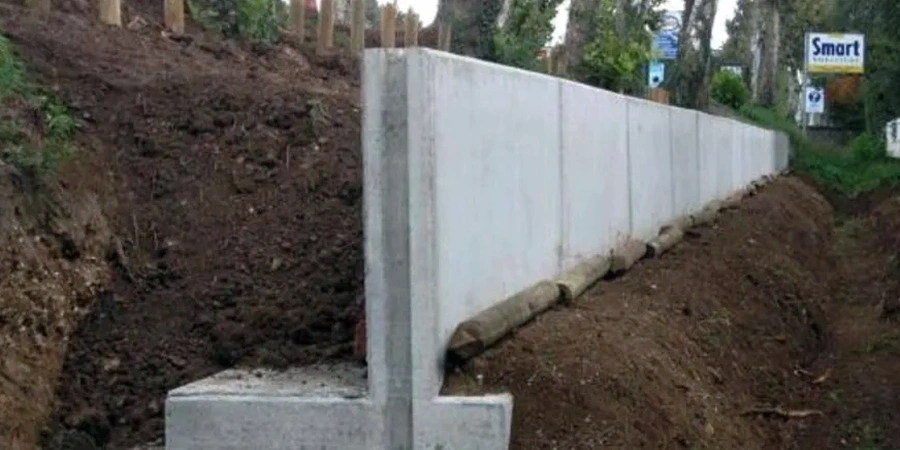
The seasonal water table fluctuation in Rockhampton can shift a retaining wall's factor of safety by 0.3 or more. We design for that.
Scope of work
Area-specific notes
Rockhampton’s subtropical climate delivers an average annual rainfall of around 800 millimetres, but the majority of that falls between December and March, often as intense cyclonic downpours. The rapid saturation of the alluvial clays reduces effective stress and can trigger a sudden loss of passive resistance at the toe of a retaining wall. If the wall lacks a properly designed drainage blanket and weep holes, the hydrostatic pressure behind the stem can double the horizontal thrust within hours. We have inspected failed walls in the Depot Hill area where the drainage stone was omitted entirely, and the backfill clay had become a semi-liquid slurry. Our designs mandate a 300-millimetre granular drainage layer wrapped in a non-woven geotextile, connected to a perforated collector pipe that discharges into the council stormwater system away from the wall face.
Standards used
AS 4678-2002: Earth-Retaining Structures, AS 1726-2017: Geotechnical Site Investigations, AS/NZS 1170.2:2021: Structural Design Actions — Wind Actions, AS 5100.3:2017: Bridge Design — Foundations and Soil-Supporting Structures
Linked services
Cantilever and Gravity Wall Design
Reinforced concrete cantilever walls designed to AS 4678 for heights up to 6 metres. We calculate sliding, overturning and bearing-pressure checks using site-specific soil parameters from our NATA-accredited laboratory. For walls on the Fitzroy floodplain we add a 200-mm blinding layer of 20-MPa concrete to spread the load and reduce differential settlement.
Mechanically Stabilised Earth (MSE) Wall Design
MSE walls with steel or polymeric strip reinforcement for heights exceeding 4 metres. We design the reinforcement layout based on the internal stability method in AS 4678, using the local granular fill from the Gracemere quarries. Each design includes a corrosion-risk assessment for the steel elements given Rockhampton's high humidity and occasional saline groundwater intrusion.
Typical parameters
FAQ
How much does retaining wall design cost in Rockhampton?
For a residential retaining wall up to 2.5 metres high, the geotechnical design fee typically ranges between AU$1.740 and AU$2.850. For commercial or infrastructure walls exceeding 4 metres, the cost can reach AU$6.290, depending on the complexity of the soil profile and the number of investigation boreholes required. These fees include the site investigation, laboratory testing, stability analysis and a signed design certificate.
Do I need a geotechnical design for a retaining wall under 1 metre in Rockhampton?
Under the Building Code of Australia and AS 4678, a wall supporting more than 1 metre of fill or retaining more than 1 metre of cut typically requires a geotechnical design. However, the reactive clays common in Rockhampton's Frenchville and Park Avenue suburbs can exert significant swelling pressures on shallow footings. Even a 0.8-metre wall founded in these clays may crack or tilt if the design does not account for the soil's expansive potential. We recommend a limited investigation for any wall that retains soil adjacent to a structure or a public footpath.
What drainage provisions does AS 4678 require for retaining walls in high-rainfall zones?
AS 4678-2002 Clause 4.6 requires that the drainage system be designed to prevent the build-up of hydrostatic pressure behind the wall. For Rockhampton's climate, we specify a granular drainage layer at least 300 mm thick, with a minimum permeability of 1×10⁻³ m/s, wrapped in a geotextile separator to prevent clogging by the alluvial clays. We also install a 100-mm perforated pipe at the base of the drainage layer, discharging to a free outlet or a stormwater pit. The wall design must verify that the drainage capacity exceeds the 1-in-20-year rainfall intensity calculated from the Bureau of Meteorology's IFD data for Rockhampton.