We use a sand cone apparatus with a 16.5 cm diameter base plate for field density tests across Rockhampton construction sites. The equipment includes a one-gallon jar, calibrated sand of known density, and a funnel assembly. We dig a test hole about 10 cm deep, collect the excavated material for moisture content determination, and measure the hole volume by filling it with the calibrated sand. The procedure follows AS 1289.5.3.1 strictly. For deep compaction layers or when access is limited, we sometimes complement the sand cone with an ensayo de placa de carga to verify modulus directly on subgrade surfaces.
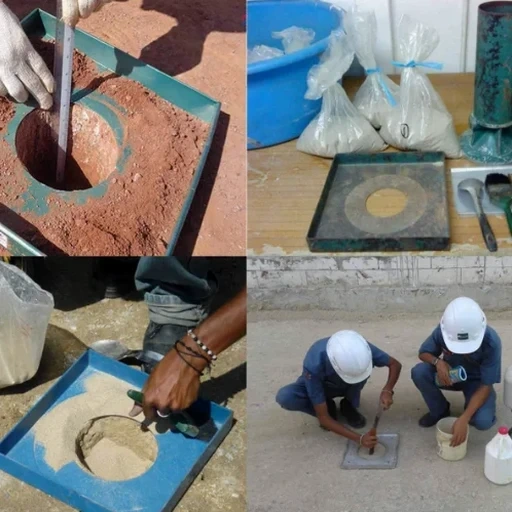
In Rockhampton’s variable alluvium and old fill, field density testing catches compaction gaps before they become settlement problems under load.
Scope of work
Area-specific notes
AS 1289.5.3.1 requires the sand cone method for granular and cohesive soils up to 20 mm particle size. In Rockhampton, the risk is old fill placed without compaction records, particularly in the flood-prone areas near the Fitzroy River. Loose fill can settle under building loads or pavement traffic. The sand cone test verifies that the achieved density meets the specified relative compaction (typically 95% to 98% of standard Proctor). If we find values below 92%, we recommend reworking the layer before proceeding. The test also detects moisture content outside the optimum range, which can cause pumping during rolling or long-term shrinkage.
Standards used
AS 1289.5.3.1:2020 – Determination of field density using sand replacement method, AS 1289.2.1.1:2020 – Determination of moisture content (oven drying), AS 3798:2007 – Guidelines on earthworks for commercial and residential developments
Linked services
Sand cone density testing for earthworks
On-site field density tests for embankments, road subgrades, retaining wall backfill, and building pads. We carry out same-day or next-day reporting with dry density, moisture content, and relative compaction against the project’s Proctor curve.
Compaction verification reports
Compiled test results with test location plans, summary tables, and pass/fail assessment per AS 3798. We highlight non-compliant zones and recommend corrective action before the next lift is placed.
This service complements our laboratory testing work for a complete project analysis.
Typical parameters
FAQ
What is the typical cost for a sand cone field density test in Rockhampton?
The cost for a single sand cone test in Rockhampton ranges from AU$160 to AU$230, depending on site access, number of tests, and whether moisture content is included. Volume discounts apply for ten or more tests on the same project.
How long does a sand cone test take on site?
A single test takes about 20 to 30 minutes to dig the hole, fill with sand, and collect the sample. Oven drying for moisture content adds 24 hours, but we can carry out wet density on the same day if needed.
Can the sand cone method be used on gravelly soils in Rockhampton?
The method works for soils with particles up to 20 mm. For coarser material (gravels up to 50 mm), we recommend the nuclear density gauge or the sand replacement method with a larger cone apparatus, both available in our fleet.
What relative compaction target do Rockhampton councils typically require?
Most local governments in the Rockhampton region specify 95% of standard Proctor density for general fill and 98% for subgrade under pavements. Check the specific development approval conditions, as variations apply for structural fill or flood-prone zones.