The geological profile of Rockhampton, sitting on the Fitzroy River floodplain, presents a mix of Quaternary alluvial clays and residual soils derived from the Berserker Beds sandstone. These clay layers, often with plasticity indices exceeding 35 and natural moisture contents near the liquid limit, are prone to significant consolidation under load. A proper settlement analysis in Rockhampton must account for the deep alluvial sequences that reach up to 15 metres in the city centre, where the water table sits 2–4 metres below surface. We combine oedometer testing per AS 1289.6.2.1 with field data from veleta-campo to obtain undrained shear strength profiles, ensuring the predicted settlements match real foundation behaviour on these compressible materials.
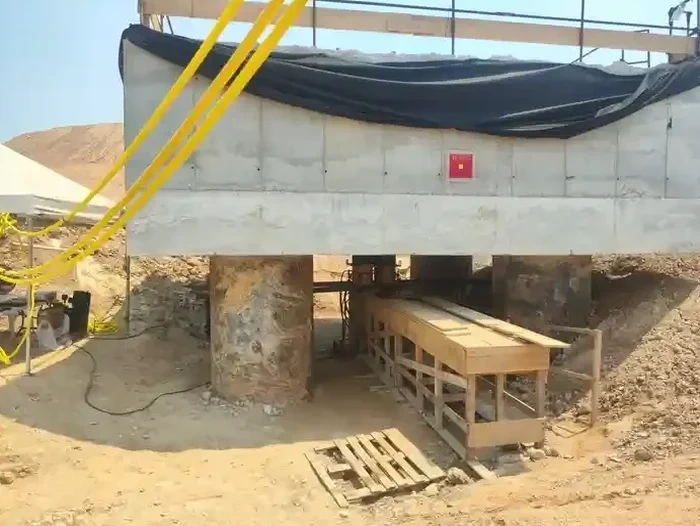
Primary consolidation in Rockhampton’s alluvial clays can account for 60–80% of total long-term settlement under typical warehouse loads.
Scope of work
Area-specific notes
A common mistake among local contractors is assuming that a single SPT blow count of 8–12 in the alluvial clay guarantees adequate bearing capacity without evaluating long-term consolidation. This oversight can lead to differential settlements exceeding 40 mm between adjacent footings, particularly where fill thickness varies across a site. Without a dedicated settlement analysis in Rockhampton, the risk of structural distress to tilt-up concrete panels and masonry walls increases substantially. We have seen cases where omitting oedometer testing resulted in slab-on-grade failures within 18 months of construction, requiring expensive underpinning. Our approach integrates undisturbed sampling, incremental consolidation testing, and analytical models that account for the city's variable alluvial thickness and groundwater regime.
Standards used
AS 1289.6.2.1 – Soil consolidation test, AS 1726 – Geotechnical site investigations, AS 4678 – Earth-retaining structures, AS 2870 – Residential slabs and footings
Linked services
One-Dimensional Consolidation Testing
Oedometer tests on undisturbed samples following AS 1289.6.2.1, with incremental loading sequences up to 1600 kPa. We determine Cc, Cr, cv, and preconsolidation pressure for each soil layer, allowing calculation of primary consolidation magnitude and rate.
Differential Settlement Modelling
Using finite-difference analyses calibrated with local soil parameters, we predict differential movements between adjacent foundations under service loads. The model accounts for variable fill thickness, soil layering, and groundwater fluctuations typical of Rockhampton's alluvial terraces.
Long-Term Monitoring & Verification
Installation of settlement plates and magnetic extensometers at critical points, with monthly readings over a minimum 12-month period. Data is compared against the predicted settlement curve to confirm that actual movements remain within tolerable limits per AS 2870 and the structural engineer's specification.
Typical parameters
FAQ
What is the difference between total settlement and differential settlement in Rockhampton soils?
Total settlement is the absolute vertical movement of a single foundation element, while differential settlement is the relative movement between two or more elements. In Rockhampton's alluvial clays, differential settlement often becomes the critical design criterion because variations in layer thickness across a site—sometimes 2–3 metres difference between the river terrace and back-swamp deposits—cause uneven movements. Even if total settlement is acceptable (say 50 mm), a differential of 25 mm between adjacent columns can crack a concrete tilt-up panel. Our analysis separates both components using oedometer data from multiple boreholes.
How long does a consolidation test take for a typical Rockhampton site?
A standard multi-stage oedometer test with four to five load increments (including unloading) requires 10–14 days from sample extrusion to final data reduction. Each load stage is held for 24 hours to reach primary consolidation, though highly plastic clays in the Norman Gardens area may need 48-hour stages. We carry out interim results for the first two load increments within 5 days to support preliminary foundation design, with the full report issued after test completion.
What is the typical cost range for a settlement analysis in Rockhampton?
The cost for a complete settlement analysis, including undisturbed sampling, three oedometer tests, index property testing, and an analytical report, typically falls between AU$860 and AU$2,620. The variation depends on the number of consolidation tests required, the depth of sampling, and whether complementary field tests such as field vane or dilatometer are included. We carry out a fixed-price quotation after reviewing the site layout and structural loads.