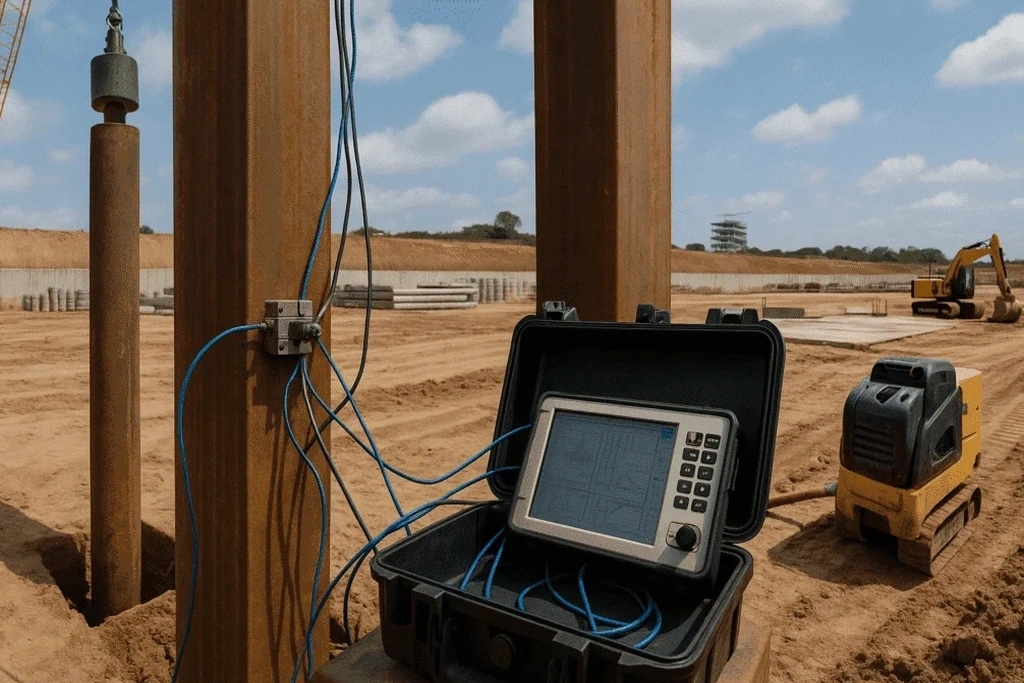
The field crew deploys a 24-channel seismograph coupled with 4.5 Hz geophones spaced at 2 m intervals along linear arrays stretching up to 140 m across the site. In Rockhampton, the team often works around the Fitzroy River alluvial plain where soft sedimentary layers can reach depths of 20 m or more. The passive microtremor array captures ambient vibrations while active MASW surveys generate Rayleigh wave dispersion curves. Combining both methods provides reliable VS30 estimates and shear-wave velocity profiles, which are essential inputs for the seismic amplification analysis that informs the design of structures in this seismically active region.
A difference in VS30 from 250 m/s to 500 m/s can double the spectral acceleration demand on a mid-rise building in central Rockhampton.
Scope of work
Area-specific notes
The subtropical climate of Rockhampton brings intense summer rainfall with cyclonic events that saturate the alluvial soils, reducing their shear strength. This seasonal moisture fluctuation directly affects the dynamic soil properties used in the seismic amplification analysis. A dry profile in August may show VS30 values 15% higher than the same profile in February after heavy rain. The presence of soft clays and loose sands in the Allenstown and Depot Hill suburbs further amplifies ground motion at frequencies between 0.5 and 2 Hz, which coincides with the natural period of 4-to-8-story buildings common in the city center. Ignoring this seasonal variability can lead to unconservative design spectra.
Standards used
AS 1170.4-2007 (Earthquake Actions), AS 1726-2017 (Geotechnical Site Investigations), NEHRP Site Classification (BSSC 2015), ASCE/SEI 7-16 Chapter 20 (Site Response)
Linked services
Active MASW & Passive Microtremor Surveys
Multi-channel analysis of surface waves using both active 10-lb sledgehammer sources and passive ambient noise recording. The combined dataset is inverted to produce VS30 maps and 1D shear-wave velocity profiles down to 30 m depth.
Site Response Analysis (1D SHAKE)
Equivalent-linear and nonlinear ground response analysis using the recorded VS profiles and strain-compatible modulus reduction curves. Output includes acceleration response spectra, amplification functions, and spectral acceleration at 0.2 s and 1.0 s periods for design.
This service complements our laboratory testing work for a complete project analysis.
Typical parameters
FAQ
What is the difference between VS30 and site class in the context of seismic amplification analysis?
VS30 is the average shear-wave velocity of the top 30 m of soil, measured in m/s. It is the primary parameter used to assign the NEHRP site class (A through F) for seismic design codes. A site with VS30 between 180 and 360 m/s falls into class D, meaning moderate amplification. In Rockhampton, many alluvial sites along the Fitzroy River are class D or even class E (soft soil), which can amplify ground motions by a factor of 2 to 3 compared to rock sites.
How much does a seismic amplification analysis cost for a typical residential project in Rockhampton?
For a standard residential or low-rise commercial project in Rockhampton, the cost of a seismic amplification analysis including MASW survey, data processing, and a site response report typically ranges between AU$1,640 and AU$3,200. The final price depends on site access, required depth of investigation, and the number of test arrays.
Can seismic amplification analysis be done on a small block in suburban Rockhampton?
Yes. For small blocks under 600 m² in suburbs like Wandal or Park Avenue, we use a compact linear array of 12 geophones spaced at 1.5 m intervals, which fits within a 16.5 m footprint. The passive microtremor method works well in confined spaces because it requires only a small triangular or L-shaped array of about 6 m per side. The results are fully valid for AS 1170.4 design.